General
Glacier Study Tour in Northern Pakistan – 12 Days (2026-27)
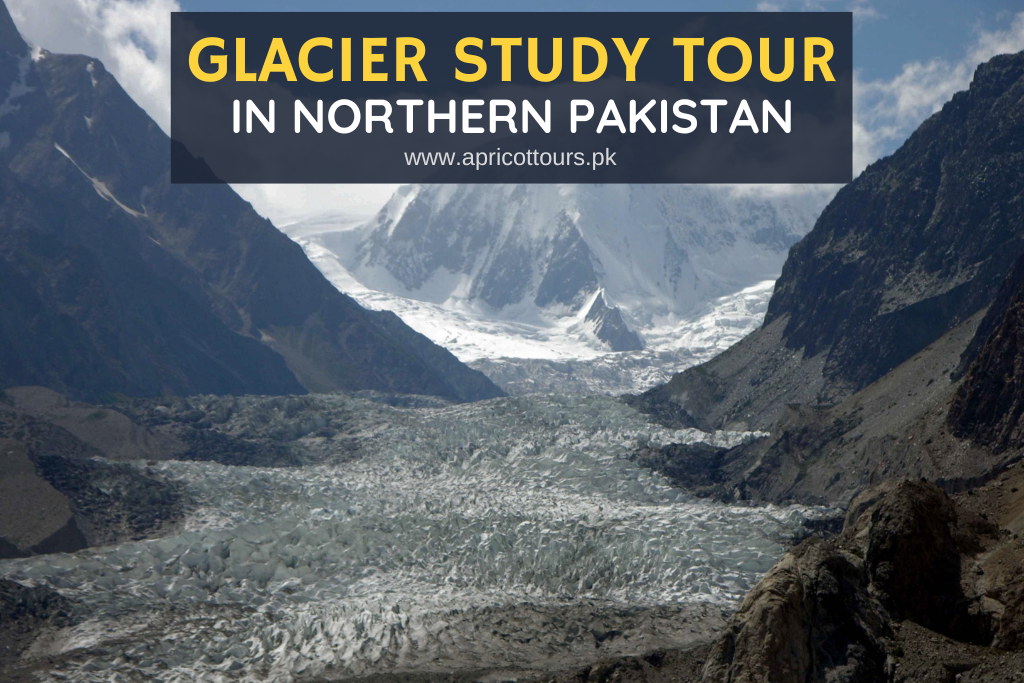
The Glacier Study Tour in Northern Pakistan provides an informative excursion across the breathtaking Karakoram glacier landscapes. Participants visit key glaciers and learn about climate change, meltwater, moraines, and mountain risks. Furthermore, the trip covers glacier monitoring, remote sensing, and GIS approaches. As a result, students, researchers, and nature enthusiasts acquire excellent field experience while learning about the environmental importance of glaciers throughout Gilgit-Baltistan.
In addition to this tour, we also offer the following Special Interest Tours, as shown in the table below.
WordPress Tables Plugin
Itinerary – Glacier Study Tour in Northern Pakistan
The itinerary for the tour is given below.
On this Day
Arrive in Islamabad and start your Glacier Study Tour in Northern Pakistan with an academic orientation to the Hindu Kush-Karakoram-Himalaya cryosphere. Participants discuss glacier genesis, mass balance, debris cover, remote sensing, and glacial lake dangers. Before embarking on the trip to Gilgit-Baltistan, the workshop will cover field safety, observation procedures, mapping techniques, and the significance of glacier meltwater in Pakistan's Indus basin.
On this Day
Travel from Islamabad to Chilas along the mountain corridor that leads into Gilgit-Baltistan. Along the way, look for varied landscapes, river terraces, steep valleys, exposed rock formations, and the Indus River system. The discussions center on how tectonics, elevation, precipitation, and temperature affect glacier formation and meltwater outflow. Chilas serves as a helpful transition point before hitting the more extensively glaciated Karakoram region farther north.
On this Day
The Karakoram Highway will take you from Chilas to Gilgit and then to Hunza. The drive displays finely carved valleys, mountain slopes, river confluences, and more evident snow-covered peaks. Participants look at how glacier-fed tributaries connect to the Hunza and Indus river basins. When you arrive in Hunza, evaluate satellite images and field maps to prepare for glacier observations around Hassanabad, Gojal, Passu, and Nagar.
On this Day
Visit Hassanabad to learn about Shisper Glacier and the surrounding hazard landscape. Concentrate on glacier surging, ice-dammed lake creation, meltwater pathways, downstream exposure, and Glacial Lake Outburst Flood hazards. Participants compare visible landforms to satellite imagery and talk about the importance of automated weather monitoring and community preparation. Field observations take into account moraines, sediment movement, changing drainage patterns, and infrastructure risk along the Karakoram Highway corridor.
On this Day
Travel into Upper Hunza and continue to Gulmit and Ghulkin, where glacier monitoring is a significant educational focus. Investigate valley geometry, glacier-fed streams, moraine deposits, and the link between communities and shifting ice systems. Participants learn how researchers use field observations and satellite data to estimate glacier size and surface change. The surrounding terrain also highlights how communities rely on cryosphere water for agriculture and other necessities.
On this Day
Conduct a concentrated field investigation near Ghulkin Glacier, utilizing safe observation locations and known access routes. Participants investigate debris cover, exposed ice, meltwater movement, moraine structure, and glacier surface characteristics. Discussions include ablation measurements, differential GPS surveying, repeat photography, and satellite image comparison. The study underlines how debris thickness affects melting rates and why repeated measurements are required to understand glacier behavior across the Karakoram region.
On this Day
Explore Passu Glacier, which is one of Upper Hunza's most accessible glacier study spots. Examine the glacier terminus, clean and debris-covered ice, crevasses, lateral moraines, meltwater channels, and valley walls. Participants compare field observations to remote-sensing imagery and talk about glacier movement, surface elevation change, and ablation stakes. The environment also demonstrates clear linkages between glaciers, mountain towns, transit corridors, and the larger Hunza River basin.
On this Day
Continue glacier observations in the Batura system near Passu, focusing on large-scale glacier morphology and the transition from ice to moraine and valley landscape. Participants investigate debris patterns, tributary ice flows, meltwater drainage, and vegetation along glacial margins. The field session compares Batura to smaller surrounding glaciers and looks at how glacier size, elevation, shade, and debris cover affect movement, melting, and long-term landscape evolution in the Karakoram.
On this Day
Return to Gojal to examine glacier-related water resources and community adaptation in Passu, Hussaini, and Gulmit. Observe irrigation channels, glacier-fed streams, cultivated land, and villages located beneath high mountain catchments. Participants examine how shifting snow and ice conditions impact water availability and dangers. Field notes are presented alongside maps and images to help connect physical glacial dynamics to agriculture, infrastructure, livelihoods, and community resilience.
On this Day
Travel from Hunza to Nagar and then to Hoper Valley, a large glacial valley beneath the high Karakoram ranges. Examine the valley contour, exposed sediments, moraines, river channels, and the large debris-covered glacier surface. Participants compare Hoper to Passu and Ghulkin, pointing out discrepancies in debris distribution and glacier shape. The method also allows you to document how glacial erosion and deposition have sculpted towns and cultivated terraces.
On this Day
Explore Hoper Glacier from safe vantage points and accessible portions, focusing on debris-covered ice, surface lowering, meltwater channels, moraines, and adjacent rockfall material. Participants talk about how scientists employ ablation stakes, differential GPS, ground observations, and remote sensing to monitor glacier change. Repeated pictures and field sketching might capture observable elements for later comparison. The program closes with a discussion about glacier dangers, runoff, and landscape development in Nagar.
On this Day
Travel from Nagar to Gilgit and then back to Islamabad via a scheduled flight, according to operating conditions. Finish the field program with a review of observations from the Shisper, Ghulkin, Passu, Batura, and Hoper glaciers. Participants compare glacier types, debris conditions, meltwater systems, danger patterns, and community dynamics. Collected notes, images, maps, and satellite observations are structured into a final study framework that connects field data to larger cryosphere research in northern Pakistan.
Dates & Cost – Glacier Study Tour in Northern Pakistan
All seasons are considered good for the tour. Considering the inflow of tourists all year round, our dates are open throughout the year, and your bookings will be 100% guaranteed even if you are a single traveler. Our prices and dates for this tour (all seasons) are given below.
| Season | Months | Tour Start Date | Price Per Person (USD) | Minimum Travellers Required | Register |
|---|
| Winter | Mid-November to February, 2026 | Daily | 1560 | 1 pax | BOOK NOW |
| Spring | March to May, 2026 | Daily | 1560 | 1 pax | BOOK NOW |
| Summer | June to Mid- September, 2026 | Daily | 1560 | 1 pax | BOOK NOW |
| Autumn | Mid-September to Mid November, 2026 | Daily | 1560 | 1 pax | BOOK NOW |
| Season | Months | Tour Start Date | Price Per Person (USD) | Minimum Travellers Required | Register |
|---|
Holiday Information
Highlights
The tour has a lot to offer. The main highlights are given below.
highlights-glacier-study-tour-in-northern-pakistan
transparent
600
#004b91
- Study Shisper Glacier and its surge hazards.
- Examine Ghulkin Glacier using field monitoring methods.
- Observe Passu Glacier and surrounding moraine systems.
- Study Batura Glacier across vast Karakoram landscapes.
- Discover Hoper Glacier and debris-covered ice features.
- Understand glacial lake hazards affecting mountain communities.
- Explore Gojal communities adapting to glacier changes.
- Learn remote sensing for glacier change analysis.
- Examine moraine deposits shaping Karakoram valley landscapes.
- Connect glacier science with Indus Basin water.
tripadvisor-reviews
transparent
600
#00a680
Overview – Glacier Study Tour in Northern Pakistan
The Glacier Study Trip in Northern Pakistan examines some of the Karakoram’s most significant glacier landscapes. The journey includes outdoor observations, environmental education, and practical knowledge of glacier evolution. Participants investigate debris-covered ice, moraines, meltwater channels, glacial movement, and shifting valley systems. Furthermore, the path demonstrates scientific monitoring techniques utilized throughout Gilgit-Baltistan. These include ablation stakes, differential GPS surveys, remote sensing, and satellite image analysis. Hunza, Gojal, Passu, Ghulkin, Shisper, Batura, Nagar, and Hoper are among the most important research areas. As a result, the tour provides important outdoor learning opportunities for students, researchers, photographers, and environmental professionals.
Furthermore, the Glacier Study Trip in Northern Pakistan links glacier science to climate change and mountain lifestyles. Participants discover how glacier changes impact water supplies, agriculture, infrastructure, and towns in northern areas. The program investigates glacial lake outburst floods, glacier surges, and hydrogeological risks. In addition, local landscapes show how researchers use field measurements, GIS, and long-term monitoring. Each destination allows you to compare glacier size, debris cover, melt trends, and surrounding topography. As a result, participants obtain a better grasp of Pakistan’s cryosphere and its significance to the Indus Basin. The journey combines education, discovery, and responsible travel across breathtaking Karakoram landscapes.
CUSTOMIZE MY TOUR
Website Last Updated: January 15, 2026
Rating
User Rating
5 based on 1 votes
Company
Apricot Tours Pakistan
Adventure
Glacier Study Tour in Northern Pakistan
Price
USD 1,560
Product Availability
Available in Stock