General
Gujjar Sar Pass Trek – Astore to Kashmir (10 Days from Islamabad) (2026-27)
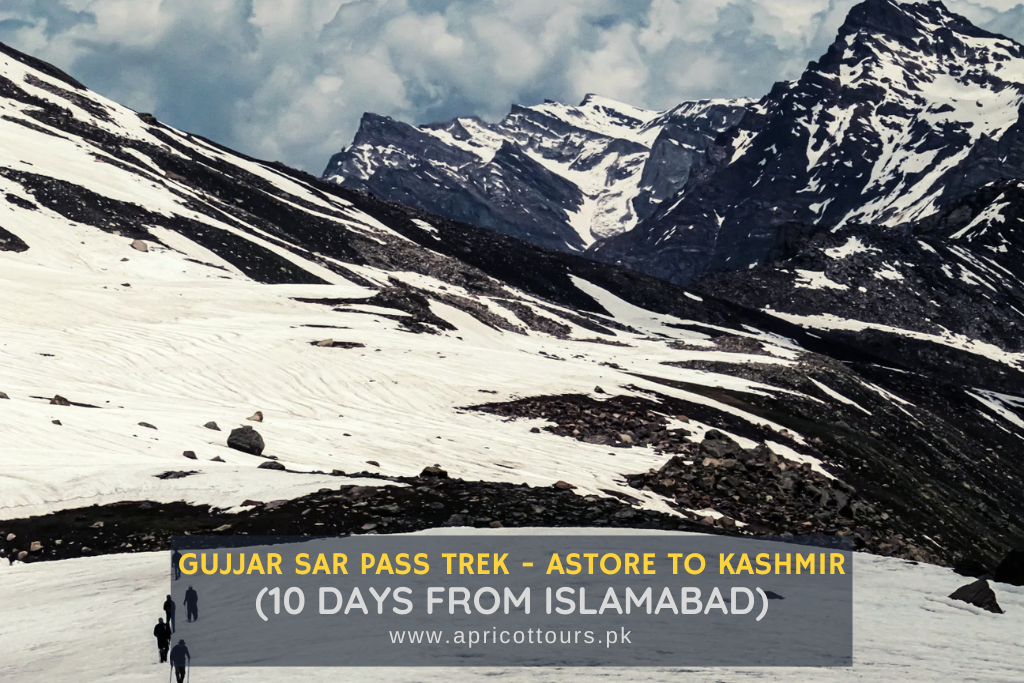
The Gujjar Sar Pass Trek from Astore to Kashmir provides an unforgettable adventure through rugged alpine scenery. The trail begins in Kalawai Valley and travels through rugged campgrounds, glacial streams, and the picturesque Damni Lakes. Trekkers also cross a stunning high pass before descending to Phullawai and Taobat. As a result, this excursion combines wildness, mountain views, cultural contacts, and an unforgettable journey between Astore and Upper Neelum Valley.
In addition to this trek, we also offer the following Astore Valley Tours & Short Treks, as shown in the table below.
Dates & Cost – Gujjar Sar Pass Trek – Astore to Kashmir
Summers are ideal for the trek. The start and end dates in the table below are your departure from and return to Islamabad. The months mentioned below are ideal for trekking in the Karakoram region of Pakistan. We have guaranteed departures every year that operate until October. Our dates and costs are listed below.
| Start Dates | End Dates | Price (USD) | Availability | Deposit | Registration |
|---|---|---|---|---|---|
| 20-Jun-2026 | 29-Jun-2026 | US$ 1,300 | Limited Space | US$ 110 | BOOK NOW |
| 20-Jun-2027 | 29-Jun-2027 | US$ 1,300 | Available | US$ 110 | BOOK NOW |
| Start Dates | End Dates | Price (USD) | Availability | Deposit | Registration |
Holiday Information
- Licensed professional guide (government requirement)
- Airport transfers on the first and last day
- All road transport in Pakistan
- Hotel accommodation in Pakistan (twin sharing rooms)
- Trekking accommodation in Pakistan (twin sharing tents)
- Hotel meals in Pakistan (breakfast, lunch and dinner)
- Trekking meals in Pakistan (breakfast, lunch and dinner)
- Trekking logistics (tents, non-personal equipments and tools)
- Support staff (cook, assistant(s) etc)
- Porters for trekking equipments, kitchen (supplies, tools, equipments, crockery, gas) and personal luggage
- Travel Insurance (recommendations only)
- Visa to Pakistan (supporting documents offered)
- International airfare
- Personal equipments (list provided on registration or request)
- Tips for guides, porters, staff etc
- Miscellaneous (drinks, phone calls, laundry, souvenir etc)
Highlights
Gujjar Sar Pass Trek – Astore to Kashmir has a lot to offer. Given below are the main highlights of the trek:
- Explore Dirlay Lake amid dramatic mountain scenery.
- Enter Kalawai Valley through remote alpine landscapes.
- Camp beneath Lower Gujjar Sar mountain ridges.
- Discover Damni Lakes surrounded by pristine wilderness.
- Experience acclimatization walks among waterfalls and streams.
- Ascend toward Gujjar Sar High Camp carefully.
- Cross Gujjar Sar Pass between Astore and Kashmir.
- Descend through Kashmir-side alpine pastures toward Phullawai.
- Reach Phullawai village after completing the crossing.
- Enjoy Taobat and Neelum Valley landscapes during return.
Itinerary – Gujjar Sar Pass Trek – Astore to Kashmir (10 Days)
The itinerary for the trek is shown below.
Day 02: Chilas to Astore and Dirlay Lake
On this Day
Leave Chilas and head toward Thalichi, where the path diverges from the Karakoram Highway into Astore Valley. Travel through tight gorges and mountain towns before arriving at Astore and continuing to Dirlay Valley. Visit Dirlay Lake, which is noted for its brilliant blue waters and magnificent mountain scenery, and then stay at a local guesthouse or camp. This gorgeous detour introduces the party to Astore's alpine setting while allowing them to organize their kit and prepare for the upcoming remote trekking portions.
Day 03: Travel to Kalawai Valley
On this Day
Travel from the Dirlay area through Astore's interior valleys to Kalawai Valley, taking appropriate local transportation for the harder roads. The road leads through increasingly remote terrain characterized by streams, grazing slopes, traditional communities, and high mountain walls. Arrive at the trekking trailhead, meet the local guide and porter crew, and inspect all camping gear. Set up your tent in Kalawai Valley, where the Gujjar Sar road begins its gradual approach to Damni Lakes and the Kashmir border.
Day 04: Trek to Lower Gujjar Sar Camp
On this Day
Begin trekking from Kalawai Valley, following shepherd trails that lead deeper into the upper basin. The path winds through streams, grassy slopes, and rugged mountain terrain, gradually gaining elevation. Cross tiny water channels and take breaks at open vistas that overlook the valley behind. Continue to Lower Gujjar Sar Camp, a sheltering spot indicated by local advisors. Set up tents near a good water supply and rest beneath the surrounding ridges before venturing into steeper, more exposed alpine territory.
Day 05: Trek to Damni Lakes
Climb from Lower Gujjar Sar Camp to the Damni Lakes valley, passing over increasingly severe alpine landscapes. Depending on the weather, the trail may pass through boulder fields, stream crossings, steep grassy slopes, and seasonal snow areas. Waterfalls and minor glacial rivers accompany sections of the climb. Arrive in the Damni Lakes region and set up your tent on safe, level ground designated by the guide. The surrounding lakes and ridgelines form one of the route's most impressive high-altitude camping areas.
Day 06: Exploration and Acclimatization Day
On this Day
Spend an additional day exploring the Damni Lakes and gradually acclimatizing. Walk between accessible lakes, waterfalls, and lofty overlooks at a moderate pace. Depending on the terrain and snow conditions, the guide may direct the group to Gujjar Sar Lake, Dhiman Lake, or neighboring nameless alpine tarns. After completing the circuit, return to the previously built camp. This adaptable stage enhances readiness for the higher camp and difficult pass crossing while providing for a better appreciation of the lake system.
Day 07: Cross Gujjar Sar Pass
On this Day
Leave Damni Lakes and climb toward the pass on steep scree, exposed rock, and possibly snowfields. Reach the summit that separates Kalawai Valley in Astore from the Phullawai-Taobat side of Upper Neelum Valley, then pause for panoramic views of both mountain ranges. Before setting up camp at a protected spot below the pass, make a cautious descent into Kashmir along unstable slopes, boulder fields, and glacier channels. This tough stage necessitates consistent weather and expert local supervision.
Day 08: Trek to Phullawai
On this Day
Continue descending from the Kashmir-side camp via alpine pastures, stream valleys, and seasonal grazing regions to Phullawai. As the road descends in elevation and approaches the inhabited Upper Neelum Valley, the vegetation gradually gets denser. Complete the trekking section near Phullawai, as this marks the end of the overland mountain crossing from Astore to Kashmir.
Day 09: Drive to Muzaffarabad
On this Day
Depart Phullawai and take the Upper Neelum Valley road to Muzaffarabad. The road runs through riverfront villages, forested slopes, suspension bridges, and settlements, including Kel and Sharda regions. Road conditions might vary greatly; therefore, a suitable vehicle and a flexible timetable are important. Continue through the lower valley until you arrive in Muzaffarabad, where you will stay at a hotel. This long transfer offers a leisurely return from the distant upper valley while maintaining uninterrupted vistas of the Neelum River corridor.
Day 10: Drive to Islamabad
On this Day
Leave Muzaffarabad and drive toward Islamabad along the mountain corridor that connects Azad Kashmir to the capital region. Before connecting to the larger highway network, the road travels through forested slopes, river basins, and developing villages. Take appropriate break stops along the way and continue to Islamabad, where the trip ends. The completed itinerary combines Astore's lakes and wilderness, the arduous Gujjar Sar Pass crossing, and the verdant vistas of Upper Neelum Valley into a demanding trans-regional trekking excursion.
Why Register Early?
1. Early Bird Discount: The given prices for the holiday are limited-time discount offers and are subject to change. Service providers including (but not limited) to airlines and hotels increase prices in peak-season. Early reservations cost less than peak-season.
2. Limited Flight Seats: Domestic flight seats to the Karakorams and Himalayas are sold out way ahead of time because there are only two daily flights during peak season. Among other things, the deposit is used to book domestic flights for you in advance.
3. Pay Balance after arrival in Pakistan: In these unusual times, we appreciate that paying the final balance for your trip may cause concern. Our policy is to only receive your final balance once you arrive in Pakistan. The only payment before arrival is the deposit.
4. Deposit valid for 3 years: We understand the uncertainty surrounding the pandemic (Covid-19). As part of our relaxed booking conditions following Covid-19, deposits are valid for 2 years.
6. Pay Minimum Deposit: The deposits for the holiday are also early-bird discounts and automatically change accordingly:
- 1st October: USD 190
- 1st November: USD 290
- 1st January: USD 350
- 15th February: USD 400
- 1st March: USD 450
- 1st May: USD 490
Note: The same dates above apply to next season's deposits.
Refund Policy for All
Deposit: Once paid, the deposit is non-refundable (but valid for 2 years) as it will be spent on making in-country arrangements.
Balance: Pay the balance only after arrival in Pakistan on the first day. Payment guidelines will be shared timely.
Currency
All international travelers can pay in US Dollars (USD) or equivalent in Euros (EUR) or Pound Sterling (GBP). Pakistani travelers are charged the equivalent in Pakistani Rupees (PKR).
Single Supplement
Separate hotel rooms (single supplement) will cost an additional USD 290. This includes all hotel nights. This payment should be made with the balance upon arrival.
Separate tents (single tent) will cost an additional USD 180. This includes the cost of additional porterage. This payment should also be made with the balance in Pakistan.

As Featured In: [logoshowcase cat_id="217"]
Photo Gallery
Overview – Gujjar Sar Pass Trek – Astore to Kashmir
The Gujjar Sar Pass Trek from Astore to Kashmir provides a unique high-altitude crossing between two breathtaking mountain ranges. The route starts in Kalawai Valley and climbs through rural fields, glacial streams, waterfalls, and steep alpine terrain. Furthermore, trekkers come to see the lovely Damni Lakes, which provide a serene location for exploration and acclimatization. Additionally, remote campsites provide beautiful skies and excellent prospects for mountain photography. The trail then continues into Gujjar Sar High Camp, passing over magnificent ridges and possibly seasonal snowfields. As a result, each stage offers a different view, ranging from Astore’s vast meadows to the pass’s austere mountain landscape.
The hard rise then continues to Gujjar Sar Pass, which is said to be between 4,000 and 4,500 metres high. The peak offers expansive views of Astore and Upper Neelum Valley. The trail then descends via rocky slopes and alpine grazing pastures to Phullawai and the neighboring Taobat. Meanwhile, the surroundings gradually become greener, with forests, streams, villages, and the Neelum River adding to the journey. This walk is ideal for experienced adventurers looking for distant landscapes, hard terrain, and meaningful cultural encounters. However, local guides, appropriate equipment, weather flexibility, and validated permissions are still required for a safe crossing.
Website Last Updated: September 15, 2026